Thursday, 4 June 2015

The controversial nature of private military contractors: the (un)just nature and the implications of the privatization of military - Amelia


Max Weber famously stated that the state is a "human community that successfully claims the monopoly of the legitimate use of physical force within a given territory." The proliferation of Private Military Contractors (PMCs) is challenging that claim and also creating debates on the controversiality of PMCs. Not the least of which is if PMCs can be considered just warriors and the implications of privatizing the military.


One of the major problems that PMCs have is that they do not have democratic and legal accountability, and as the examples below will show, this lack of accountability enables them to violate Just War Theory (see also the video). It is my opinion that it is the lack of accountability that means that PMCs are not considered just warriors. 


PMCs enable the circumvention of democratic accountability by both the companies and the government. Private military companies do this because they undermine governmental institutions through negating one of the core governmental roles, which is “to maintain security, which includes democratic control over the use of force.” By not being beholden to the citizens, they have no restrictions on the contracts they accept or seek out, which can have a debilitating impact on national or international security á la Executive Outcomes (EO) attempting to seek out contracts to fight for the genocidal Rwandan government. EO’s attempt shows the near violation of the jus ad bellum principles of just cause and right intention. As Robert Young Pelton said, "it is a myth to assume that contractors are aligned with governments, that they synchronize."

The government’s use of PMCs undermines democratic accountability because it circumvents the legislative assembly’s input into the decision to intervene and the subsequent decisions. In those cases, would there be just cause to invade the country if it is likely that the public or the legislative assembly would disapprove? Also, PMCs removes the morality of the engagement in war as the use of national military forces the governments to use force as a last resort because it is their citizens that they are putting in danger. But by outsourcing military force, the government would be able to engage at will. One important side effect of this is losing control over how that force is used during the intervention. This loss of control relates to jus in bello (JIB) in its entirety because it concerns the conduct of war by PMCs.

In general, there is a huge difference between a state military and private military in that while the government has control over their soldier’s actions, they don’t have control over the contractor actions. When soldiers break the law, they are court-martialed but when contractors break the law, what happens? The PMCs lack of legal accountability is exacerbated because their corporate status makes them virtually immune from international treaties, and military law only applies to civilians when there has been a formal declaration of war, which does not happen a lot these days.

This means that the contractors can violate, with impunity, the JIB principles because while the military has to ensure that soldiers are acting in accordance to JIB, PMCs are not under any obligation to do so. Cases in point, the Sierra Leonean government terminated the contract with EO after the company was subjected to allegations of human rights abuses; CACI and Titan Corp. were implicated in 36% of the incidents in the Abu Ghraib prison scandal and there were 6 individuals that were directly culpable; and there is a video implicating Aegis Defense services in the random shooting at Iraqi civilians during a street patrol and shows that they not only violate military necessity, but also proportionality and distinction. These are just a few examples, but what they have in common is that the contractors involved weren’t persecuted. 
Furthermore, PMCs are ultimately accountable to their employers rather than the state, which means that they follow the orders of senior management, whose goals are often in line with profit maximization rather than upholding JIB. The goal of profit maximization run the risk of hiring unsuitable employees or not providing adequate training, amongst other things (video).

Another reason for not considering PMCs just warriors is that private military companies do attract a certain type of people. Singer argues that many former members of the most notorious and ruthless units of the Soviet and apartheid regimes have found employment in the industry. Looking at EO, a significant portion of their contractors was derived from Koevoet and 32 Battalion, units that were notorious for their human rights violations during the Apartheid. Although it is possible that people can change, the fact that the disbandment of Koevoet took a long time as those operatives were considered unsuitable for work in law enforcement suggests otherwise. This is evidence that PMCs do not discriminate against their potential employees, which creates problems when taking into account the lack of democratic and legal accountability.

My opinion is that while I don’t believe that PMCs are inherently unjust, the current lack of regulation and democratic and legal accountability means that PMCs are not considered just warriors is because unlike the state military where there are checks and balances in place to ensure JIB is upheld, there is none for PMCs. 

Implications of the privatization of the military
National and international security are being increasingly threatened by the proliferation of PMCS. The UN Working Group on the Use of Mercenaries wrote that PMCs fill power vacuum in unstable countries. When those governments are not functioning and are not able to control the actions of the PMCs, those contractors would have the freedom to act however they want. Bearing in mind the type of people PMCs normally attract and the emphasis on the bottom line, there could be the proliferation of human rights abuses and this would impact on national security because the citizens would not feel secure within their own state. It could also spill over into international security due to a possible exodus of refugees.

With regards to international security, borrowing an example from pop culture because I wasn’t able to find real life examples, The Expendables are a group of ex-soldiers that banded together and are in the employ of the CIA. In Expendables 3, the group comes up against an ex-Expendable that had left the group and became an illegal arms trader. Although this is fictional, this is one real way that PMCs can impact international security. While this is not saying that national soldiers don’t do this, but a combination of globalization, increased usage of weapons and the lack of regulation of the industry increases the chance of illegal arms trade by PMCs. Moreover, in the environments that they are working in, they would probably get to know people, which facilitate the ease of changing jobs, as seen in Expendables 3.
Another way that PMCs threaten international security is through the increasing demand of their services. This is because PMCs create a cycle of self-perpetuating supply due to the creation of more security experts which then leads to a demand on their services that are only limited by the number of actors that can pay for them and lastly, weakening existing security institutions due to draining of resources, that is talented personnel, and worsening the security coverage. This cycle enables the dependence of the poorer African nations because they end up needing more and more services from the PMC due to the PMCs’ recruitment of the state’s talent. The consequence is that security infrastructure and governmental organizations remain woefully underdeveloped which impedes the reconstruction of society and adds to existing international problems.
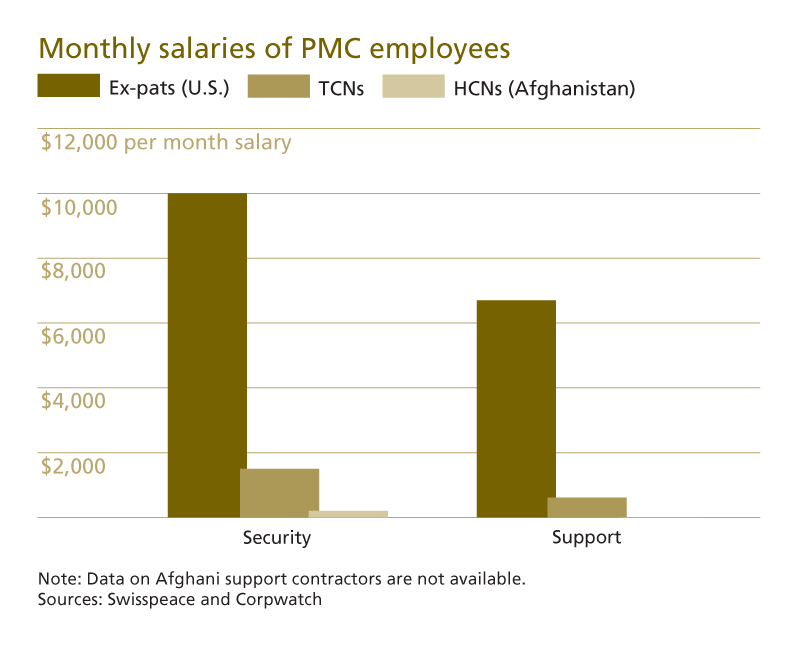
Lastly, there is a brain drain in the military because private security pays much more compared to governmental pay, although there is a difference depending on the contractor's country of origin. Military morale is also affected because soldiers are working alongside someone that is being paid at least 3 times they are. This brain drain is causing the military to lose talent, which means that all that’s left will be the incompetent ones. States should not be protected by those who aren’t able to, and there is no need for all countries to have the jokes about their military causing worldwide disasters because of lack of basic army discipline. Just the Russians.

Wednesday, 3 June 2015

Blackwater in Iraq: When private companies claim neoconservative responsibility

Sunnie Hwang

Mercenaries have a long and complicated history. In the past it was private companies that funded expeditions to faraway lands to conquer new territories and gather resources. Arguably, the Dutch East India Trading Company was the first major wholly private military. Recently, Private Military Companies (PMCs) have come to fill the niche created by the end of the Cold War and downsizing of national militaries. Peter Singer defines private military contractors as “profit-driven organisations that trade in professional services intricately linked to warfare. They are corporate bodies that specialise in the provision of military skills - including tactical combat operations, strategic planning, intelligence gathering and analysis, operational support, troop training, and military technical assistance.” 

PMC personnel receiving combatant status is both a blessing and a curse for all parties involved. Legitimate national military personnel require combatant status to justify their behaviour on the battlefield. Without this, and the other laws applicable in international war, the soldier is simply carrying out murder. Prisoner of War status is also crucial for those captured by the opposition, as it protects troops against human rights abuses. By denying PMCs this status, they occupy the ambiguous position of providing military type services without the same rights as national military personnel. However, categorising private military contractors as anything other than civilian holds the danger of legitimising their behaviour and transforming the blame of violent actions as necessary in the course of war. 


Blackwater, currently known as Academi, is one of the largest private military employers with multiple contracts with the United States defence forces and a large combat presence in Iraq. As a private company, Blackwater is an illegitimate force spreading political ideologies and foreign policy. Those concerned with PMCs financial motives need not worry, as the company argues that it is doing more than just providing military services for monetary gain. Being motivated by financial gain can seem unethical as the conventional idea of soldier is one of noble and selfless do-gooder. However, the international community cannot expect all those who engage in warfare to have motives akin to Kantian principles of moral purity. As far as war goes, the intention and actions of the warrior – whether he be national military or a private contractor – is irrelevant in the grand scheme of war. Why the Blackwater security guards fired on innocent civilians at Nisour Square is far less important than the fact they did this with intent to kill. Their motives behind firing their guns pales in significance to the fact that they did. Weber argues that universal morality applies in all situations, but those with pure moral and ethical motives do not necessarily behave in the right way for war.


With this in the back of our minds, let us turn to the notion on PMCs intervening in foreign nations with the intention to spread the Western ideals of democracy and liberty. Blackwater was largely unknown until March 31st, 2004, when four Blackwater contractors were killed and their bodies hung for the world to see in Falluja, Iraq. Since this incident the growth of PMC presence in Iraq has ballooned to equal the amount of U.S. troops.  PMC personnel have come under scrutiny since they entered Iraq, with accusations of violence, disrespect and immoral war conduct. Unethical behaviour in war does occur, but it is less so the motive behind this behaviour and more about the intention. This moral Kantian argument also extends to those authorising and hiring PMCs. The end of the Cold War, and subsequent growth of PMCs in the past two to three decades has failed to see effective oversight in the recruitment, vetting and supervision of private military contractors.

PMC advocates call to praise the prosecution and conviction of the four Blackwater security guards by the U.S. justice system as a victory for the accountability of private contractors hired by national governments. While a step in the right direction, supervision and accountability in the realm of private military companies and contractors remains highly unregulated. States PMCs operate in largely lack a willingness or ability to prosecute wrongdoers. Kirkuk 2006, two civilians killed. May 2006 en route to Baghdad airport, a civilian killed and his wife and daughter severely injured. Erbil 2009, three women wounded. While disturbing, these incidents are a mere fraction of the overall numbers where private contractors have abused the grey area they occupy. Arguing for the spread of Western democratic ideals and under the guise of legitimacy bestowed upon PMCs by state-funded contracts, private security contractors have committed atrocious acts and rarely been brought to justice. The video below highlights an incident as those described:


Near the end of the video, Cenk Uygur outlines why neoconservative and PMC justifications for participating in Iraq fail 

As leaders in the global political arena, the United States has failed to recognise the dangers of handing over so much power to an unregulated, private force. The rapid rise of PMCs is responsible for the absence of supervision, and retroactive regulation is unlikely, particularly as the Obama administration has approved new contracts to increase the number of private military personnel in Iraq as U.S. troops prepare to decrease their military presence. Following the neoconservative political ideologies of the George W. Bush administration, companies such as Blackwater consider their duty as global security companies to spread the ideals of Western democracy and liberty. In this sense, it is not private companies intervening in foreign nations because they are being paid to do so. Rather it is from an ideological standpoint these company executives decide to take on clients. Should the international community continue to allow these private corporations to act on behalf of national governments to implement Western ideologies they claim to believe in?

Combatant or civilian, the international community must decide where private military contractors sit in the battlefield. The ambiguity brought forth by different theorists and interested parties only allow the abusers to violate international rules of war without fear of prosecution. Whether they are massacring civilians in Nisour Square  or running over innocent women like in the video above, these actions make it difficult for the international community to believe Blackwater take on their clients to push the neoconservative agenda to better the lives of people in foreign lands. Rather, the neoconservative appeal serves as justification for the noble cause, instead of accepting contracts based solely on financial gain, Blackwater wishes to appear motivated by the “right” reasons.

What Justifications Have Been Given for the Use of torture?

The prohibition against torture expresses one of the democratic West’s most powerful taboos which has been successfully made illegal by international law.

Article 3, common to the four Geneva Conventions establishes fundamental rules from which no derogation is permitted. It requires humane treatment for all persons in enemy hands, without any adverse distinction. It specifically prohibits murder, mutilation, torture, cruel, humiliating and degrading treatment, the taking of hostages and unfair trial.

In 1984 an international human rights treaty: The Convention against Torture and Other Cruel, Inhuman or Degrading Treatment or Punishment aimed to prevent torture and other acts of cruel, inhuman, or degrading treatment or punishment around the world. However, torture remains a practice among many nations even today. Perhaps what is most puzzling is the use of torture by the United States a nation that prides itself of liberal democratic values. 
So the question arises: why do these nations such as the United States a nation that prides itself of democratic values, still use torture today? What Justifications have been given for the use of torture?

Abu Ghraib and Guantanamo Bay
In March 2003 during the war in Iraq the United States Army and the Central Intelligence Agency committed a series of human rights violations against detainees in the Abu Ghraib prison in Iraq. The abuses came to light with reports published by Amnesty International and the Associated Press in late 2003. These violations included physical and sexual abuse, torture, rape, sodomy, and murder.

Detainees held in the United States' Guantanamo Bay detention camps in Cuba have initiated hunger strikes at Guantánamo Bay, and camp medical authorities have initiated force-feeding programs.
One detainee recalled, "Being strapped to a chair and having a tube forcibly inserted through one's nostrils and into one's stomach is dishonorable and degrading," according to the motion for a preliminary injunction. "It falls within the ambit of torture."

President Bush and his colleagues have often stated that the United States does not condone torture. Soon after the first set of suspected terrorists were sent to Guantanamo Bay in 2002 he said that America’s armed forces would treat the detainees ‘humanely’ in manner ‘consistent with the Geneva Conventions’ but ‘only’ ‘to the extent appropriate and consistent with military necessity’. There has been a wide use US military torture euphemisms such as, enhanced coercive interrogation technique, special methods of questioning, consistent with military necessity, all words to replace the taboo word of torture. It isn’t just the words used that have tried to excuse the practice of torture it is the practice itself that has been justified.

Ticking bomb scenario
To understand the justifications used for torture we must know the background of how it has been used by the United States during the War on Terror.
In every war, information is a weapon. Therefore in war one must extract this information and disarm the offender. Hence in the War on Terrorism where the enemy does not wear a specific uniform and hides among civilians, information is even more important.

Let us imagine a scenario: suppose you know that there is a bomb. And suppose you also know the identity of someone who knows the location of this bomb, the time of when it will explode, and who else was involved in this potential terrorist attack. If this bomb goes off it may kill hundreds maybe even thousands of innocent lives.
Given the threat that terrorist pose to innocent lives isn’t it justified for governments to do what ever they can to protect their citizens? Isn’t it better for one guilty person to be tortured than to risk the lives of hundreds or thousands? Would you allow this one man to be tortured to extract information? And potentially save innocent lives?

This scenario has come to be known as the ticking bomb scenario. This scenario is a thought experiment that has been used in the ethics debate over whether torture can ever be justified. The case of torture is based on the three fundamental value sets at stake. The safety and security of the nation’s citizens, the preservation of individual human rights and democratic openness and accountability.

One American criminal-defence lawyer Alan Dershowitz stated that the new threats do justify a limited use of non-lethal torture in extreme cases and proposes that judges be given the ability to issue ‘torture warrants’.
In a BBC survey of 27,000 people in 25 countries conducted in 2006 found that more than one out of three people considered a degree of torture acceptable if it saved lives. Opposition was highest in most European and English-speaking countries. Another poll in 2005 by the Pew Research Centre found that nearly half of all Americans thought the torture of suspected terrorists were sometimes justified.

However, life isn’t as simple as a ticking bomb scenario. Alex Bellamy argues that the ticking bomb terrorist case is based on a series of unlikely assumptions designed to prejudge the moral outcome.
Firstly we assume that the suspected terrorist does know whereabouts of the ticking bomb, and that under torture the truth will spill and therefore save innocent lives.  We are left to decide for our own how much torture would be permitted? Many critics of the ‘ticking bomb’ also claim that torture is ineffective in this scenario as people will say anything just to stop the pain. The information may not be correct and therefore lose more time for the bomb to explode (Bellamy, 2006).

Bellamy argues for the prohibition of torture and claims that one; torture does not always work as the torturers often claim. Second, torture violates jus in bello principle of non combatant immunity. And third, claiming a moral right to torture prisoners to extract information creates a precedent for others nations to use (Bellamy, 2006).

So in conclusion we can see that this issue of torture is not very clear. If we were to take the question and answer it in words only it would be simple. Is torture ever justified? Under international law it is an absolute no. Article 2 in the Convention against Torture states:
No exceptional circumstances whatsoever, whether a state of war or a threat of war, internal political instability or any other public emergency, may be invoked as a justification of torture.
However, to a great number of people and to many nations across the world and in the case of the War on Terrorism, the answer to the ticking bomb scenario is a yes, it is indeed justified under the framework of the ticking bomb scenario.

Written by: Kevin Huh

References:

Bellamy, Alex J. 'No Pain, No Gain? Torture And Ethics In The War On Terror'. International Affairs 82, no. 1 (2006): 121-148. 
International Committee of the Red Cross. 'The Geneva Conventions of 1949 and Their Additional Protocols', 2010. https://www.icrc.org/eng/war-and-law/treaties-customary-law/geneva-conventions/overview-geneva-conventions.htm.
BBC NEWS. 'One-Third Support 'Some Torture'', 2006. http://news.bbc.co.uk/2/hi/6063386.stm#table.
RT News. 'Gitmo Detainees Ask US Court To End Force Feeding', 2013. http://rt.com/news/gitmo-strike-court-petition-507/.
Sontag, Susan. 'Regarding The Torture Of Others'. New York Times, 2004. http://www.nytimes.com/2004/05/23/magazine/regarding-the-torture-of-others.html.
Sussman, David. 'What's wrong with torture?.' Philosophy & Public Affairs 33, no. 1 (2005): 1-33.
The Economist. 'Fight Terrorism: Is Torture Ever Justified?', 2003. http://www.economist.com/node/1524784.
The Economist. 'Is Torture Ever Justified?', 2007. http://www.economist.com/node/9832909.
United Nations. 'Convention Against Torture And Other Cruel, Inhuman Or Degrading Treatment Or Punishment', 1984. http://legal.un.org/avl/ha/catcidtp/catcidtp.html.


What is Urbicide?

URBICIDE by Peter Park

So what is Urbicide? It is a combination of words 'Urban' and '-cide' and it was after the war in Bosnia that the term was first begun to be used by scholars. 
The official definitions are; 
1. Deliberate wrecking or killing of the city, 
2.Destruction of built environment. 

As you may have noticed, the term '-cide' is a human-centric term as it means 'to kill or cut a human being'. i.e.. homicide: to kill a person by another person. Suidcide: to kill oneself. etc.
The scholars who first began to use this term obviously meant to portray buildings or man made structures as victim, not as dispensable objects. 

According to Martin Coward, a senior lecturer at New Castle University, Urbicide is a distinct form of political violence.

He explains his definition as follows;

1. Built environments are not merely back drops of human lives but represent relationships between you and your surroundings. When you walk out the door, you'll see various different built structures such as the house next door, a church across the street, dairy store down a block, bus stop 200m to the left of your house, etc. You form your life based on that physical relationship between you and your surrounding structures as a guide.

2. Built structures represent how, when, where, with whom we interact and conduct our daily lives. As you structure your life guided by your direct relationship with your surrounding structures, you construct your relationship with other human beings within that geographical frame. For example, first thing you do since moving into that neighbourhood is to drop by the local dairy to buy news paper. You developed that habit because the dairy happens to be very close to your home and the store owner strikes pleasant conversations every morning. What a good way to start the day!  

3. Built structures are gathering spaces through which communities ( polis) are formed based on such interactions.

Ok. brief extra definition or rather, a history of a word polis here would be extra helpful. 
The word comes from the Greek word from which the title of Aristotle's books Politics (politika) derives: "affairs of the cities", a dissertation on governing and governments, which was rendered in English in the mid-15th century as Latinized "Polettiques". Thus it became "politics" in Middle English . The singular politic first attested in English 1430 and comes from Middle French politique, in turn from Latin politicus,[2] which is the Latinization of the Greek πολιτικός (politikos), meaning amongst others "of, for, or relating to citizens", "civil", "civic", "belonging to the state",[3] in turn from πολίτης (polites), "citizen"[4] and that from πόλις (polis), "city

So, the attack on buildings are attack on communal political culture,  thus urbicide is a political violence on the whole community. 

Furthermore, in my personal view, the building are materialisation of our ideals. Of course we build to make our lives convenient, but at very fundamental level we imagine our lives before we build certain structures, imagine the specific venues where we dream of enriching our lives interacting with others there, conduct businesses here and even just resting there. Destruction of built environment is attack on very personal level that impacts on every member of the society.


Slaveneka Drakulic 

Slaveneka Drakulic is a Croatian writer and she described this sentiment (that of building being the expression of collective human ideals) through her memoir of Bosnian War, especially the destruction of Stari Most bridge, in which she expressed feeling more sorrow at seeing the collapsed bridge than a woman whose throat has been slit. Because the bridge represented every one of the society. 

Below is a short video clip of the Stari Most (Old Bridge) being deliberately targeted and destroyed by artillery fire. You can see the bridge is already in horrible state due to continued battle there but it was kept as best by the locals. Tires, wood sticks, boards, and wires are used to hold them together (and to offer some cover from sniper fire)

Top is a beautiful photo of the original bridge before the war. (Digitally enhanced of course!)
You can almost feel the pain when looking at the video clip.


Max Weber,( a German renaissance man, as he was a economist, Sociologist, Historian, Jurist, Philosopher, and Political Scientist)
said “City is a place of civility and other formation of urban culture” 
- If I correctly interpreted his definition of a city, the destruction of a city structure means a destruction of civility and culture and violence against it is an introduction of something very foreign, anti-culture, and anti-civilization.  - I can not agree more especially after seeing above photo & video.


Stephen Graham in his article, ‘Lessons in Urbicide’ points out that Urbicide usually requires planning, whereas ‘urban-destruction’ merely states destruction of inorganic representation of materials which form the shape of city. 

His example of IDF action against Palestinian in Operation Defensive Shield perfectly demonstrates scope of Urbicide and how it is very deliberate.  

Below is the brief description of the IDF's Operation Defensive Shield.

  • Operation Defensive Shield:
      - Primary Weapon: Armoured C9 CAT Bulldozer
     -  40,000 Sq metre destroyed
     -  52 Palestinians killed
     -  140 multi-family housing blocks demolished
     -  1500 damaged
     -  4,000 residents displaced (as their house no longer exists)
     -  Cultural and administrative facilities destroyed

The picture below demonstrates how the bulldozer did the damage. As you can see, the operation is designed to make life difficult for Palestinians. Destroying the road and sidewalk... what for? 


  • Purpose was to destroy urban foundation of a proto-Palestinian state, and to improve IDF monitoring of Palestinians, to create buffer zone around Jewish settlements.
  • Israel govt intended to strangle all forms of civic life by destroying any modern facilities that are essential to contemporary livelihood - de-modernisation of Palestinian area followed by Modernisation of Jewish settlements adjacent to it. - creating stark contrast between the Palestinians and Israelis. 
  • Also, method of 'strangulation' of civic life and immobility followed in the form of curfew, random raid, random arrests, check points, walls, road blocks, and surveillance. .. and destruction of the road networks. 

  • Motivations for Urbicide - Israeli case
  • 1. Demographic Anxieties: dwindling Jewish population growth rate vs. exponential Palestinian birth rate which would overtake Jewish population by 2020. Extensive walls built to stop expanding urban areas and to separate Jewish area and Palestinian area. - division, a separation from previous relationships within the city. 
  • 2. Medical imagery : Israeli officials saw the urbanisation of Palestinian area as ‘cancer’ which needs to be wiped out before causing bigger trouble for Israel. 
  • 3. Unclean Spaces: dense unplanned urbanisation rendered Israeli monitoring of the Palestinian population highly ineffective. Increasing urban warfare means Palestinians may have upper-hand in future urban battles. Ease of attack and ease of surveillance required for Israel.  
    ** Operation Defensive Shield not only destroyed housing blocks, but also electronic communications, water tanks, computers in businesses and houses, financial or operational records of small businesses also confiscated and burned. Hospitals were also bombed and some ambulance crew were shot and killed as they attempted to cross the operational zone to help the wounded Palestinians. 
  • Key Characteristics of many Urbicide
  • Systematic Planning & involvement of large number of participants
  • Rationalisation of actions - they always argue for military necessity or for better living spaces, etc etc. 
  • Always targets densely populated area - to maximise damage and to make the effect longer lasting.
  • Dehumanizes the population - often the victims are called rats, cockroaches, or cancer.
  • Targets most symbolic cultural structures

  • Some notable cases

  • New York City - Urban Renewal (1951) which destroyed predominantly African-American neighbourhood so white businessmen could develop and make profit


  • Atomic bomb on Hiroshima and Nagasaki
  • Zimbabwe : Operation Restore Order
  • Nazi Germany - destruction of Polish buildings.